
A Deep Dive into Smart Manufacturing Factory Implementation and Measurable Business Impact
Company Profile
TechForge Manufacturing is a mid-sized precision engineering company specializing in automotive and aerospace components. Founded in 1998, the company operates two manufacturing facilities in the Midwest with 450 employees and annual revenue of $89 million.
Company Snapshot
- Employees: 450
- Annual Revenue: $89 Million
- Manufacturing Facilities: 2
The Challenge: Legacy Systems in a Digital World
By early 2023, TechForge Manufacturing faced growing competitive pressure from digitally mature manufacturers. Despite strong product quality, outdated systems limited efficiency, visibility, and scalability.
Key Challenges Identified
- Production inefficiency with Overall Equipment Effectiveness (OEE) at 62% (industry benchmark: 85%)
- High defect rate of 3.8%, causing $2.1M in annual waste and rework
- Manual data collection preventing real-time decision-making
- Reactive maintenance resulting in 18 hours of unexpected downtime per month
- Rising customer demand for real-time order tracking
- Difficulty attracting younger, tech-savvy talent
Leadership recognized that incremental fixes would not be enough. A full digital transformation became essential for long-term survival.
“Digital transformation wasn’t a luxury—it was survival.”
— Sarah Chen, CEO, TechForge Manufacturing
The Strategic Approach: Phased Implementation
TechForge adopted a structured, phased approach to minimize operational risk while maximizing learning and ROI.
Phase 1: Foundation and Assessment (Months 1–3)
- Process mapping of production workflows
- Infrastructure and network audit
- Employee skills and training assessment
- Vendor evaluation for IoT, analytics, and integration
- Definition of KPIs tied to business outcomes
- Formation of a cross-functional transformation team
Phase 2: Pilot Program (Months 4–8)
The pilot covered one production line (15% of total output).
Pilot Highlights
- 47 IoT sensors installed across 12 machines
- Edge computing for real-time alerts
- Cloud-based analytics dashboards
- Predictive maintenance models
- Digital work instructions replacing paper SOPs
Initial challenges included sensor placement issues, network latency, and dashboard customization needs—each resolved before full rollout.
Phase 3: Full-Scale Deployment (Months 9–18)
Timeline
- Months 9–11: Infrastructure and sensor expansion
- Months 12–14: AI-powered analytics and optimization
- Months 15–16: Workforce training
- Months 17–18: Optimization and fine-tuning
Implementation Highlights and Key Technologies
Smart Manufacturing Stack
- 327 industrial IoT sensors
- Edge computing devices
- Cloud analytics platform processing 2.3TB/month
- AI/ML models for maintenance, quality, and scheduling
- Digital twin of production environment
- 180 tablets for shop-floor staff
Change Management
- 12 internal “Digital Champions”
- 6,400 training hours delivered
- Gamified performance tracking
- Weekly employee feedback sessions
- Incentives linked to digital KPIs
The Results: Measurable Business Impact
After 24 months, TechForge achieved exceptional results.
Key Metrics
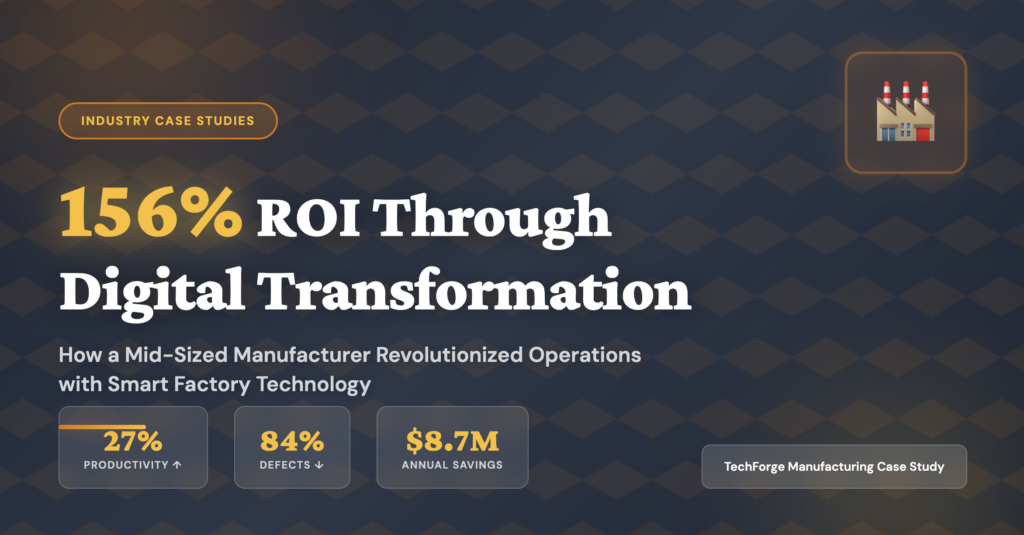
- ROI: 156%
- Productivity Increase: 27%
- Defect Reduction: 84%
- Maintenance Cost Reduction: 41%
- OEE Improvement: 92%
- Annual Cost Savings: $8.7M
Operational Improvements
- OEE improved from 62% to 92%
- Throughput increased by 27%
- Setup times reduced by 34%
- Energy consumption reduced by 18%
Quality Improvements
- Defect rate reduced from 3.8% to 0.6%
- First-pass yield improved to 99.2%
- Customer complaints reduced by 76%
Maintenance Improvements
- Unplanned downtime reduced by 72%
- Equipment lifespan extended by 3–5 years
- Inventory carrying costs reduced by $340,000
Business Growth
- Won 8 new major contracts
- Lead time reduced from 6 weeks to 3.5 weeks
- On-time delivery improved to 98%
- Customer satisfaction increased by 34 points
Financial Summary
Total Investment: $5.6M
- Hardware & sensors: $1.8M
- Software & cloud: $1.4M
- Integration & consulting: $1.2M
- Training & change management: $0.7M
- Contingency: $0.5M
Annual Benefit: $8.7M
Payback Period: 7.7 months
“We moved from firefighting to forward-thinking.”
— Marcus Johnson, VP Operations
Critical Success Factors
- Strong executive sponsorship
- Pilot-first rollout strategy
- Frontline employee involvement
- Business-focused KPIs
- Experienced technology partners
- Heavy investment in training
- Continuous improvement mindset
Challenges Overcome
- Employee resistance to change
- Legacy ERP integration
- Poor initial data quality
- Increased cybersecurity risks
- Data science skill shortages
Each challenge was addressed with structured solutions and people-first strategies.
Key Takeaways for Manufacturers
- Start with business strategy, not technology
- Pilot before scaling
- Invest in people and training
- Ensure system integration
- Measure outcomes, not tools
- Build scalable architecture
- Secure leadership buy-in
- Celebrate quick wins
What’s Next for TechForge
- Advanced digital twin simulations
- Computer vision quality inspection
- Autonomous material handling
- Supplier visibility portals
- Blockchain-based traceability
Conclusion
TechForge Manufacturing’s journey proves that mid-sized manufacturers can achieve transformational results with the right strategy and execution. The 156% ROI was driven not by technology alone, but by cultural change, leadership commitment, and disciplined execution.
Digital transformation is no longer optional. For manufacturers willing to act decisively, it offers a clear path to sustainable competitive advantage.